
Composer
Enterprise AI does not become useful because it can talk. It becomes useful when it can work — safely, selectively, and only through capabilities the business has approved.
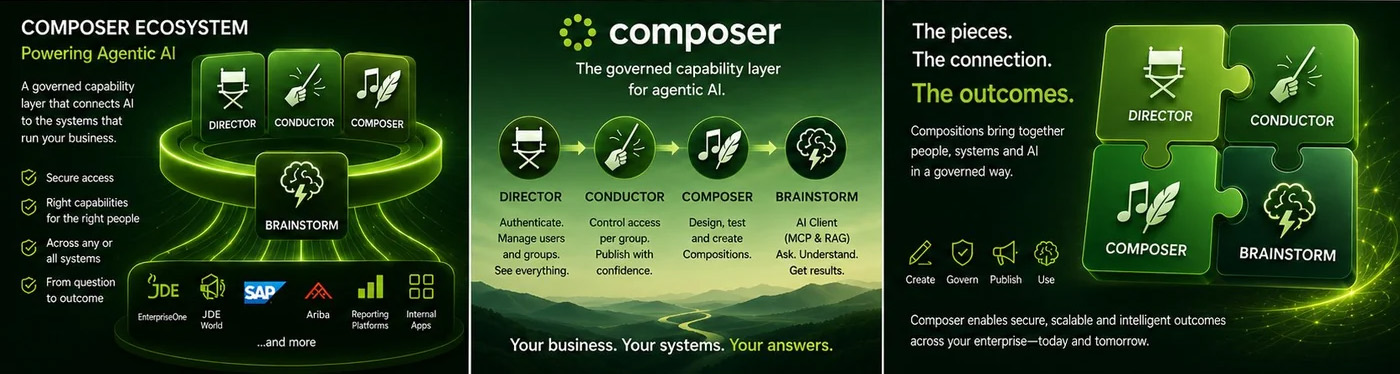
Compositions are a new governed capability layer for enterprise AI. They turn business know-how into reusable capabilities that can be created, controlled, published, and safely used by agentic AI — across one system, many systems, or the full landscape of the business.
The family is deliberately simple. Composer creates Compositions. Director provides identity, access, user and group management, and central visibility of every registered node. Conductor controls which Compositions are available to which groups, and publishes them to approved consumers. An AI client — BrainStorm, or another you approve — then uses those published Compositions to move from conversation to practical business outcomes.
Composer creates. Director governs. Conductor publishes. Your AI acts.
- Capabilities the business defines — not prompts, not guesswork.
- One system, several, or the whole landscape.
- Every capability gated by group. Users see only what suits their role.
- Published deliberately. Nothing reaches an AI client by accident.
- Central identity, access and node visibility.
- BrainStorm is one consumer — and remains a separate product.
A governed agentic AI route for JD Edwards World
Search for agentic AI solutions for JD Edwards World and there is very little to find. Most ERP AI offerings assume a newer application tier, while World organisations are left with generic chatbots, isolated data experiments, or a migration project they did not ask for.
Composer closes that gap by turning approved JD Edwards World data, business rules and procedures into named capabilities an AI can use safely. These may provide conversational answers, controlled operations, or one coherent result assembled from World and the other systems around it. They are created once, governed centrally and published only to the groups entitled to use them.
BrainStorm supplies the conversational agentic AI experience. Composer supplies the governed World capabilities it can act through. JD Edwards World remains JD Edwards World: no EnterpriseOne conversion, AIS installation or Orchestrator dependency is implied.
- Agentic AI for JD Edwards World
- AI agents for JDE World
- JD Edwards World AI assistant
- AI for WorldSoftware on IBM i
- AI automation for AS/400 ERP
- Modernise JD Edwards World with AI

An AI that can do anything is an AI you cannot deploy.
Give an AI broad reach into the systems that run a business and you have created something nobody will sign off. Give it none, and you have a chatbot. The industry has spent two years stuck between those two answers.
Compositions resolve it by changing what the AI is given. Instead of access, it is given capabilities: specific, named, reviewed things the business has decided are safe and useful — and nothing else. The AI cannot exceed them, because it was never handed the means to.
That is what makes this deployable. The question in the room stops being “what might it do?” and becomes “which capabilities have we approved?” — a question a business can actually answer, in a meeting, with names on it.
- Broad access → approved capabilities
- “What might it do?” → “What did we approve?”
- One system at a time → one answer, from wherever the truth lives
- Conversation → outcome
Layered guidance, so an agent reaches the same result the same way
A capability layer is not only a list of things an AI may do. It is also the guidance that tells an agent when to do them, what they need, and what to do when the answer is unwelcome. That guidance is published alongside the capability, so every consumer receives the same instructions about the same capability.
The layers narrow the problem in sequence. What survives all of them is a selected operation with checked parameters — not a plan the model composed on the spot.
- Entitlement. Conductor publishes to groups; Director decides who is in which group. What is not published to a user does not exist for them.
- Purpose. Each Composition and Orchestration carries its own description of what it is for and when it applies, so selection is informed rather than inferred from a name.
- Shape. Parameters are typed and validated. An incomplete request becomes a question, not a guess.
- Standing rules. Deployment-wide instructions govern the awkward cases: ambiguity, missing data, warnings, and figures that must always arrive with their basis.
- Confirmation. Anything that changes data is read back and named before it runs.
- Determinism at the end. The capability executes as it was built and tested. Same capability, same parameters, same outcome — every time, for every consumer entitled to it.
This is what makes a catalogue worth more than a collection: guidance is written once, published once, and inherited by every process that uses the capability.
- Guidance improves once and every entitled process gets the improvement.
- A correction made to a capability is a correction everywhere it is used.
- Two agents asking the same thing perform the same operation, because they were published the same capability with the same instructions.
A monolithic “agent” has to relearn all of this privately, per process, and prove it again each time.
What is inside a “Payables Agent”, really?
When a vendor shows you a “Payables Agent”, a “Buyer Agent” or an “Order Entry Agent”, you are rarely looking at one indivisible piece of intelligence. You are looking at a package: data acquisition, entity resolution, business-rule validation, deterministic ERP operations, exception handling, approvals, monitoring — and a conversational interface on the front.
The Compositions family assembles those same outcomes from reusable, black-box capabilities — and in important respects that is the stronger model. The supplier-resolution capability the “Buyer Agent” needs is the same one the payables process needs. The item and availability capabilities, the document-status checks, the approval steps — built once, governed once, reused by every agent and every process entitled to them.
So this is not just a platform you could build capability on. It is a platform that arrives with an initial catalogue of packaged business capabilities — and every capability you add joins the same catalogue, under the same governance, available to every outcome that needs it. When the alternative is commissioning another monolithic agent for every process — each with its own overlapping copy of the same plumbing, separately priced and separately governed — the catalogue does not merely keep up. It compounds.
- Data acquisition
- Entity resolution
- Business-rule validation
- Deterministic ERP operations
- Exception handling
- Approvals and confirmation
- Monitoring and reporting
- A conversational interface
Each one a reusable capability here — not another agent’s private plumbing.
Four ways to package a capability
Different outcomes call for different building blocks. Compositions come in three kinds — and the Orchestrations you have already built join the catalogue as they are.
Capture the know-how
Every business runs on knowledge that lives in people: which checks matter before a supplier is approved, what “ready to ship” actually means, where the real number comes from when two systems disagree. Composer turns that knowledge into a capability that can be used again, by anyone entitled to it, without the person who knew it being in the room.
Make it reusable
A Composition is built once and used indefinitely. It does not decay when the author moves on, and it does not have to be rediscovered by the next team who needs it.
Keep it under control
Nothing a Composition can do is a surprise, because the business decided what it does. Capabilities are reviewed before they are published, published to named groups rather than to everyone, and withdrawn the moment they should be.
Turn conversation into outcome
Users stop needing to know which system holds which answer, which team owns which process, or which path leads to the right result. They ask for the outcome. The approved capability delivers it.
Composer creates
A productive place to build reusable business capabilities — and to keep improving them as the business changes.

Director governs
Identity, sign-on, users, groups and access — plus a live view of every registered node. More →

Conductor publishes
Decides which Compositions reach which groups, and releases them to approved consumers. More →

BrainStorm acts
One consumer of the layer — and a separate product. It works on its own; with Compositions it works on your business. More →
BrainStorm remains independent, and is sold separately. Compositions make it more capable. Director makes it controlled. Conductor makes it selective. Composer makes it practical.
And the whole ensemble is scalable by design. Add a capability and everyone entitled to it has it. Add a system and it is governed like everything else. Add a thousand users and nobody decides anything twice.
One system, many, or the whole landscape
Compositions can be created for JD Edwards EnterpriseOne, JD Edwards World, Ariba, SAP, reporting platforms, internal applications, partner systems, and beyond.
One source or several. One answer, assembled from wherever the truth lives.
This is the part that changes the conversation with the business. The question a user has is almost never confined to one system — but the tools they were given always were. A capability is not obliged to respect that boundary, and the person asking should never have had to.
- JD Edwards EnterpriseOne
- JD Edwards World
- SAP
- Ariba
- Reporting and analytics platforms
- Internal and bespoke applications
- Partner and third-party systems
Nothing is implicit
A capability reaches a user because someone decided it should. Compositions are published to groups, and a user sees only the capabilities their groups allow. A user with no group sees nothing beyond what is explicitly public.
Withdrawing a capability is a single act, and it takes effect for everyone who held it.
Central identity
Director owns sign-on, users, groups and access for the whole family. There is no second place where a user might exist, and no component that can be reached around it.
Visible by design
Every node registers itself with Director and reports in continuously. What is deployed, where, on which version, and whether it is healthy — on one screen. An administrator can approve a node, or disable it, and that decision is enforced centrally rather than requested politely.
A question your security team can answer
“What can the AI do?” has a list for an answer. That list was reviewed, it is versioned, and it is enforced — which is a materially different conversation from the one most AI projects are currently having.
Licensing
Annual subscription, sized by the systems your Compositions reach and the population entitled to use them — not by the handful of people who author them. Authoring seats are included: the last thing we want to do is charge you for building more capability. A fixed-price Pilot / Proof-of-Value is available to remove buyer risk. Contact us for a demo or quote, or see the pricing page for editions and indicative figures.
Director and Conductor are not separately licensed. They are how Composer is governed and delivered, and they come with it.
Governance and capability guides
Explore how the Compositions family handles identity, publication, reusable capabilities and work that spans more than one business system.
The argument, in full
Independent guides on the JDE Citizen Developer website. No sales pitch — just the problem, and what it takes to solve it.
Composer creates. Director governs. Conductor publishes. BrainStorm acts.
A governed capability layer for agentic AI — reaching across JD Edwards, Ariba, SAP, reporting platforms and the applications you built yourself, to deliver coherent answers and practical outcomes.
Order or Inquire